Dead Soil Is Killing Your Yard—Here's How to Bring It Back to Life
You've overseeded. You've fertilized. You've watered on a schedule, pulled weeds by hand, and spent real money on plants the nursery promised were foolproof. And still—thin grass, yellowing leaves, bare patches that refuse to fill in.
Before you blame your climate or your luck, check under your feet. Because in most struggling yards, the real problem isn't what's growing. It's what's underneath it.
Soil health is the most overlooked variable in residential landscaping, and it's the one that determines whether everything else works or fails. You can have the right plants, the right watering schedule, and the right fertilizer—but if your soil is compacted, depleted, or biologically dead, none of it will save you.
Let's talk about what's actually going on down there, and what you can do about it.
What "Dead Soil" Actually Means
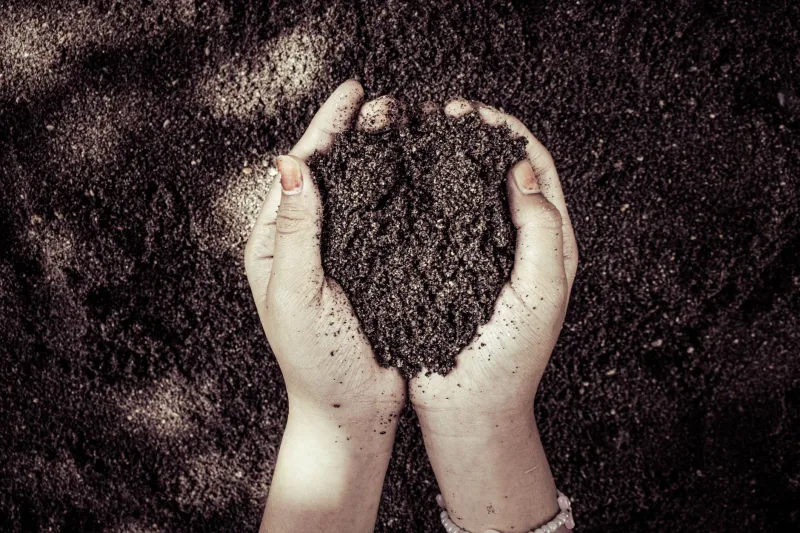
Healthy soil isn't just dirt. It's a living ecosystem—teeming with bacteria, fungi, earthworms, and microscopic organisms that break down organic matter, cycle nutrients, and create the loose, crumbly texture that plant roots need to thrive.
When soil dies, it doesn't disappear. It just stops working. It becomes compacted and dense, blocking water and air from reaching roots. It loses its microbial population, so nutrients aren't processed efficiently even when you add them. It becomes hydrophobic in some cases—actually repelling water rather than absorbing it.
The causes are everywhere in the typical American yard: years of synthetic fertilizer use that bypasses organic matter, heavy foot traffic, construction activity, clay-heavy native soil that was never amended, or simply decades of neglect.
The frustrating part is that dead soil looks almost identical to healthy soil on the surface. You have to dig—or test—to know what you're dealing with.
Step One: Get a Soil Test (No, Really)
A soil test is the single most cost-effective thing you can do for your yard, and most homeowners skip it entirely. For around $20–$40, your local cooperative extension office (every state has one) will analyze a sample and tell you your soil's pH, nutrient levels, and organic matter content—along with specific amendment recommendations.
This matters because guessing is expensive. If your soil is already high in phosphorus and you keep adding it, you can actually lock out other nutrients. If your pH is off—too acidic or too alkaline—plants can't absorb the nutrients that are already present, no matter how much you fertilize.
Collect samples from several spots across your yard, mix them together, and send in the combined sample. Most extension offices return results within two weeks. Think of it as a blood panel for your lawn.
The pH Problem Most Homeowners Don't Know They Have
Soil pH is measured on a scale from 0 to 14, with 7 being neutral. Most lawn grasses and landscape plants prefer a range of 6.0 to 7.0. Outside that window, nutrient uptake gets dramatically less efficient—even if those nutrients are present in abundance.
Acidic soil (below 6.0) is common in the Southeast and Pacific Northwest, where heavy rainfall leaches calcium and magnesium over time. The fix is relatively simple: lime applications, either calcitic or dolomitic depending on your magnesium levels.
Alkaline soil (above 7.5) is more common in the arid West and Midwest, often tied to naturally high calcium carbonate content. Sulfur amendments can help, though alkaline soil is generally harder to correct and may require longer-term management.
The key point: without knowing your pH, you're essentially treating symptoms while ignoring the underlying condition.
Compaction: The Silent Killer
Compacted soil is one of the most common problems in suburban yards, and one of the most damaging. When soil particles are pressed tightly together—by foot traffic, mower weight, or years of settling—pore spaces collapse. Water can't penetrate, roots can't expand, and oxygen levels drop.
You can do a simple screwdriver test: push a standard screwdriver into moist soil. If you can't get it to 6 inches without significant force, your soil is compacted.
Core aeration is the most effective solution. A core aerator pulls small plugs of soil from the ground, creating channels for air, water, and nutrients to reach the root zone. For most lawns, aerating once a year in the appropriate season (fall for cool-season grasses, late spring for warm-season) makes a significant difference within one to two growing seasons.
Follow aeration with a top dressing of quality compost—a quarter to half inch spread evenly across the lawn. As it breaks down, it feeds soil biology and improves structure simultaneously.
Organic Matter: The Thing Your Soil Is Starving For
Modern lawn care practices have a tendency to strip organic matter rather than replenish it. Bagging clippings removes what would otherwise decompose and feed the soil. Synthetic fertilizers bypass the organic cycle entirely. Herbicides can affect soil microbes.
The fix isn't complicated, but it requires consistency. Compost is the most versatile and accessible soil amendment available—it improves drainage in clay soil, increases water retention in sandy soil, and feeds microbial life in all soil types. You can make it or buy it in bulk.
Leave grass clippings on the lawn when you mow (mulch mowing). Top dress planting beds with compost each spring. Use organic mulch around trees and shrubs and let it decompose naturally over the season.
None of this is dramatic. But over two to three years, the cumulative effect on your soil—and everything growing in it—is transformational.
When to Bring In Reinforcements
For severely degraded soil—compacted clay, heavily contaminated areas, or spots where construction fill was used—you may need more aggressive intervention. Biochar amendments can improve long-term soil structure. Mycorrhizal inoculants introduce beneficial fungi that dramatically improve plant root efficiency. In extreme cases, replacing the top 6–8 inches with quality topsoil and compost blend may be the most practical path forward.
These aren't cheap options, but they're still less expensive than replacing dead plants, reseeding failed lawns, or continuing to throw money at a yard that's fighting you because the foundation is broken.
The Bottom Line
Every dollar you spend on your yard—fertilizer, plants, irrigation, sod—works harder in healthy soil. Every dollar you spend in dead soil is partially wasted. Fixing your soil isn't glamorous, and it doesn't produce Instagram-worthy results overnight. But it's the upgrade that makes every other upgrade actually work.
Start with a test. Build from there. Your yard will thank you in ways that are hard to explain until you've seen it happen.