Why Your Backyard Feels Like a Stranger's House (And How to Fix It)
You spent real money on that patio furniture, strung up the lights, maybe even added a fire pit—so why does your backyard still feel like somewhere you visit instead of somewhere you live? It's not bad taste or a tight budget. It's a handful of fixable problems that most homeowners never think to look for.
This is your outdoor living audit. Work through it honestly, and you'll walk away knowing exactly which changes will actually move the needle.
Start With the Honest Question: Do You Actually Go Out There?
Before you diagnose anything, track your real behavior for one week. How many times did you step outside just to hang out—not to mow, not to grab something from the shed, just to be there? If the answer is fewer than three times, your yard has a usability problem, not just an aesthetic one.
Spaces we love get used. Spaces that feel awkward, uncomfortable, or incomplete get avoided. That avoidance is data. It's telling you something specific.
Check Your Furniture Placement First
This is the number one culprit, and it's almost always overlooked. Most people arrange outdoor furniture the same way they'd arrange a living room—pushed against walls or fences, leaving a big empty void in the middle. Outside, that layout kills conversation and makes the space feel like a waiting room.
Instead, pull seating inward. Create a defined center—a table, a fire pit, a large planter—and orient chairs toward it. You want people facing each other, not staring at a fence. If your current layout has everyone sitting in a row, that's your first fix.
Also ask yourself: is there enough seating for how you actually entertain? If you typically host six people but only have four chairs, the math doesn't work and people stop coming outside.
Run a Lighting Audit After Dark
Go outside at 9 p.m. and just stand there. If you can't see your feet, if the shadows feel a little eerie, or if the only light is one harsh overhead fixture that washes everything out—you've found a major reason why evenings outside aren't happening.
Good outdoor lighting has layers. You want:
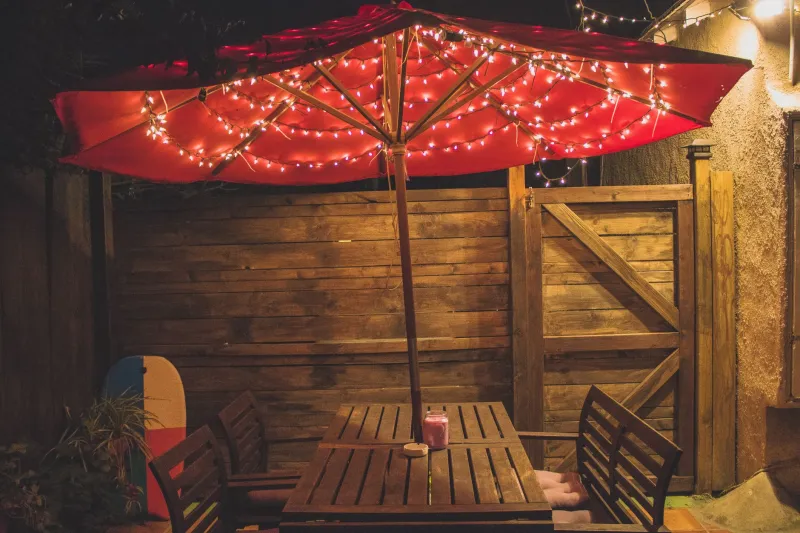
- Ambient light to define the space broadly (string lights, lanterns)
- Task light where you're cooking or eating
- Accent light to highlight trees, planters, or architectural features
Path lighting and low-voltage ground lights add depth and make a yard feel curated rather than just lit. This doesn't have to be expensive—solar-powered stake lights and plug-in string lights can completely transform an outdoor area for under $100.
Listen to Your Yard
This sounds strange, but hear us out. Sensory experience drives whether a space feels relaxing or stressful. Sound is a huge part of that.
If your backyard soundtrack is traffic noise, a neighbor's AC unit, or just silence that feels hollow, you're missing a layer that high-end outdoor spaces almost always include: water sound.
A small tabletop fountain, a bubbling urn, or even a modest pond feature creates white noise that masks urban sounds and signals to your brain that this is a calm place. You don't need a full koi pond. A $60 fountain from a garden center does the job.
Wind chimes, rustling ornamental grasses, and even a well-placed bird feeder add acoustic texture that makes a yard feel alive.
Smell Matters More Than You Think
Scent is deeply tied to memory and comfort. A yard that smells like cut grass and nothing else is fine—but a yard that hits you with jasmine, lavender, or fresh herbs the moment you step outside? That's a yard you want to be in.
Audit your planting. Do you have anything fragrant near your seating area? Some easy wins:
- Lavender along a path or patio edge (zones 5–9)
- Gardenias near a door or window (zones 8–11)
- Rosemary in a pot near the grill (almost everywhere)
- Sweet autumn clematis on a fence or trellis (zones 4–9)
If your outdoor space is mostly hardscape with zero scent, you're leaving a powerful comfort tool completely unused.
Evaluate Your Shade Situation
America has a sun problem in backyards. Specifically, we build gorgeous patios and then wonder why nobody uses them between 11 a.m. and 4 p.m. in July.
If your seating area gets direct sun during peak hours and there's no overhead coverage—umbrella, pergola, shade sail, or mature tree—you've essentially built a space that's only comfortable for about four months of the year in most of the country.
A cantilever umbrella is the fastest fix. A shade sail is affordable and modern-looking. A pergola with a climbing vine is a longer-term solution that adds significant value. But do something. Unshaded spaces in warm climates sit empty.
Look for the Missing Transition
One underrated reason yards feel disconnected: there's no clear transition between inside and outside. You walk out a sliding glass door and you're just... in the yard. No visual cue that says this is a destination.
Simple transitions that work:
- A defined threshold (a different material underfoot, like pavers vs. deck boards)
- Container plants flanking a door
- A short pergola or arbor at the entry point
- A change in elevation, even just one step down
These small signals tell your brain you've arrived somewhere intentional. They make the space feel designed rather than leftover.
Your Audit Checklist
Go through these questions and mark what needs attention:
- Furniture faces inward toward a focal point
- Enough seating for your typical gathering size
- Layered lighting including ambient, task, and accent
- A water or sound element to mask noise
- At least one fragrant plant near the seating area
- Shade coverage during peak afternoon hours
- A defined transition from the house to the outdoor space
- At least one focal point that draws the eye (fire feature, sculpture, large planter)
If you checked fewer than five of these, you've got your roadmap. Pick the two that feel most doable this weekend and start there. You don't need a full renovation—you need the right fixes, in the right order.
Your yard should feel like an extension of your home, not an afterthought behind it. The good news? Most of these gaps are easier and cheaper to close than you'd expect.