Your Lawn Is Struggling—And You're Probably the Reason Why
Let's be honest for a second. You water consistently. You fertilize a couple times a year. You mow every weekend like clockwork. And yet your lawn still looks patchy, stressed, or just... fine. Not great. Not the thick, green carpet you're going for.
Here's the uncomfortable truth that the lawn care industry doesn't always advertise: a lot of the most common yard routines are actively working against you. Not because homeowners are lazy—but because a lot of popular advice is outdated, oversimplified, or just flat-out wrong for most US climates and grass types.
Let's talk about what's actually going on.
The Daily Watering Trap
This is the big one. If you're running your sprinklers every morning for 15–20 minutes, you're creating shallow-rooted, water-dependent grass that struggles the moment conditions change.
Grass roots follow moisture. When you water lightly and frequently, roots stay near the surface because that's where the water is. The result is a lawn that wilts fast during a hot week, browns quickly in drought conditions, and becomes a prime target for fungal disease—because the surface stays perpetually damp.
The correction is straightforward but counterintuitive: water deeply and infrequently. Most established lawns need about 1 to 1.5 inches of water per week. Deliver that in two sessions rather than seven, and water long enough to push moisture 4–6 inches into the soil. This trains roots to go deep, which means a tougher, more resilient lawn all season long.
Bonus: you'll also cut your water bill. Win-win.
Mowing Too Short, Too Often
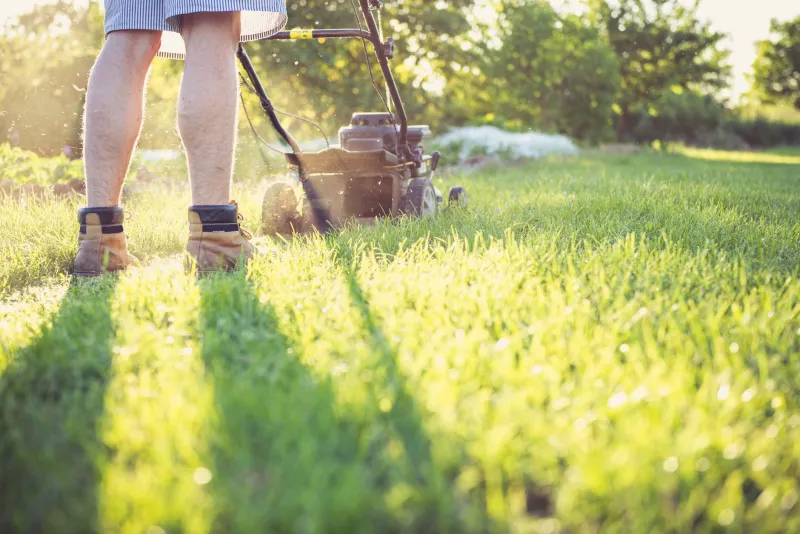
The "scalped" look might seem tidy, but cutting your grass too short is one of the fastest ways to stress it out. When you remove more than one-third of the blade in a single mow, the plant goes into survival mode—redirecting energy away from root development and toward recovering leaf surface.
Every grass type has an ideal mowing height. Kentucky bluegrass and fine fescues thrive at 2.5 to 3.5 inches. Bermuda grass can handle shorter cuts around 1 to 1.5 inches. Zoysia sits somewhere in between. When you mow lower than recommended, you're exposing soil to direct sun, drying it out faster, and giving weeds the exact conditions they need to take hold.
Mow at the right height and leave the clippings. Yes, leave them. Grasscycling returns nitrogen to the soil and reduces the need for supplemental fertilizer by up to 25%. A mulching blade on your mower makes this even more effective.
Fertilizing on the Wrong Schedule
Bag timing matters more than most people realize. Applying a high-nitrogen fertilizer in late spring or early summer to a cool-season lawn—like tall fescue or bluegrass—is the equivalent of force-feeding someone a huge meal right before they're about to take a nap. Cool-season grasses slow down dramatically in summer heat. Pushing growth during that period stresses the plant and makes it more vulnerable to disease.
Cool-season lawns should be fertilized primarily in fall, when the grass is actively recovering and storing nutrients for spring. A light application in early spring is fine, but fall is where the real work happens.
Warm-season grasses like Bermuda, St. Augustine, and zoysia flip this completely—they want fertilizer in late spring through summer when they're actively growing, and nothing in fall as they head into dormancy.
If you're not sure what you're growing, your local cooperative extension office (searchable through the USDA's NIFA website) can tell you exactly what's in your lawn and what it needs.
Using the Wrong Fertilizer Altogether
Not all fertilizer is the same, and grabbing whatever's on sale at the hardware store is a gamble. The three numbers on every bag—nitrogen (N), phosphorus (P), and potassium (K)—tell you a lot about what you're actually putting down.
Most established lawns in good soil don't need high phosphorus. In fact, many states now restrict or outright ban phosphorus fertilizers for residential use because of runoff concerns. A standard maintenance fertilizer for most lawns should lean heavier on nitrogen and potassium.
Get a soil test before you buy anything. You can pick up a test kit at most garden centers for under $20, or send a sample to your local extension lab for a detailed breakdown. This one step alone can save you from wasting money on nutrients your soil already has in abundance—and from creating imbalances that invite weeds and disease.
Ignoring Your Equipment
Dull mower blades are a silent lawn killer. A sharp blade cuts cleanly. A dull one tears and shreds the grass tip, leaving ragged edges that turn brown, invite disease, and make your lawn look stressed even when it isn't.
Blade sharpening should happen at least once a season—twice if you're mowing regularly on a larger lot. It's a $10–$20 service at most small engine shops, or a 20-minute DIY job if you're comfortable with a file or bench grinder.
While you're at it, check your mower's tire pressure if it has pneumatic tires. Uneven pressure causes uneven cuts, which shows up as a striped, patchy appearance that has nothing to do with your grass health.
The Myth of "More Is Better"
Lawn care has a tendency to attract the overachievers. More water. More fertilizer. More treatments. But grass is a living system, and like most living things, it responds poorly to constant intervention.
Overwatering creates anaerobic soil conditions that suffocate roots. Over-fertilizing burns grass and triggers rapid, weak growth. Over-treating for weeds and pests disrupts the soil biology that healthy lawns depend on.
Some of the best-looking lawns in any neighborhood belong to homeowners who've simply learned to do less, but do it right. Correct timing, appropriate amounts, and proper technique beat intensity every time.
Small Fixes, Real Results
You don't need to tear up your routine and start from scratch. Adjust your watering schedule. Raise your mower deck a notch. Get a soil test before your next fertilizer purchase. Sharpen your blade before the season kicks off.
These aren't dramatic overhauls—they're small corrections that compound over time. And by next summer, you might just be the neighbor everyone else is quietly jealous of.